Microbial and Phytoremediation Strategies for Agricultural Soil Bioremediation: Mechanisms and Future Perspectives
Prem Ranjan
Department of Agricultural Microbiology, Indira Gandhi Krishi Vishwavidyalaya, Krishak Nagar, Raipur, Chhattisgarh 492012, India.
Neha Saini
ICAR-National Bureau of Agriculturally Important Microorganisms, Kushmaur, Mau Nath Bhanjan, UP, India.
Vindhya Bundela *
Department of Microbiology, Govind Ballabh Pant University of Agriculture and Technology, Udham Singh Nagar, Pantnagar, Uttarakhand 263145, India
*Author to whom correspondence should be addressed.
Abstract
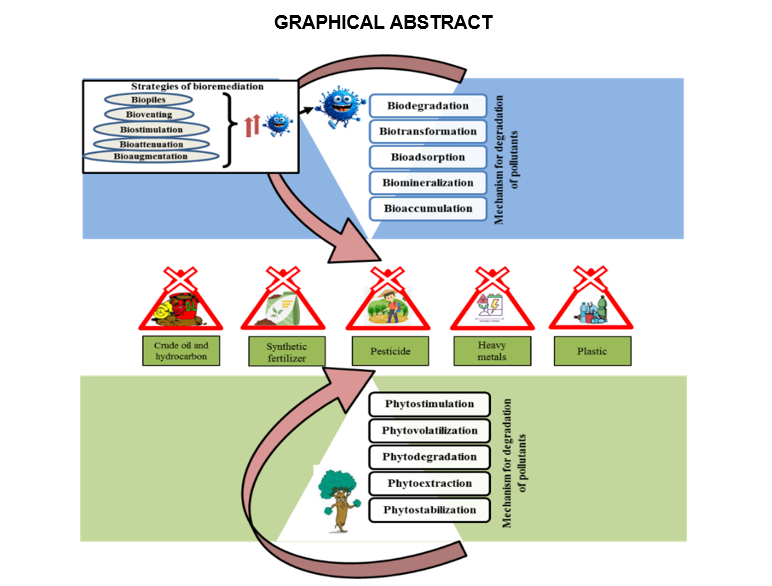
Bioremediation is an eco-friendly approach that utilizes microbes and plants to effectively remove a wide range of pollutants from the soil. Various strategies—such as bioventing, biopiling, biostimulation, bioattenuation, and bioaugmentation—are employed to enhance biological processes, breaking down complex soil contaminants into simpler, non-toxic forms. These byproducts are absorbed by plants and microorganisms, contributing to a healthier environment. While extensive research exists on bioremediation techniques and microbial mechanisms, reports on their practical applications and proven benefits remain limited. Therefore, developing effective bioremediation strategies is crucial to degrade pollutants at scale, preserve nutrient availability, and optimize microbial populations and processes, including biodegradation, biosorption, biomineralization, bioaccumulation, and biotransformation, tailored to specific contaminants. This paper reviews various bioremediation approaches and their potential as viable solutions for addressing emerging environmental pollutants. With continued advancements, microbial and phytoremediation could mitigate pollution and promote long-term environmental health.
Keywords: Bioremediation, contaminants, bioremediation strategies, microbial remediation, phytoremediation